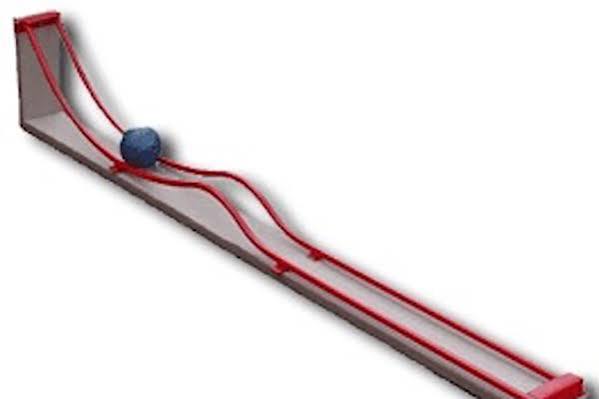
Before there were consoles, there was a wooden box with a steel marble and two knobs. The labyrinth toy — tilt the surface, guide the ball, avoid the holes — is arguably the oldest ancestor of every ball-rolling game ever made, and its DNA is all over Roller Baller.
Why a ball?
Game designers keep returning to the rolling ball for one reason: it's the most honest character in gaming. A ball has no animations to hide behind, no abilities to memorise — just momentum, gravity and friction, physics everyone already understands from childhood. When a ball-game feels wrong, players know instantly. When it feels right, it's almost hypnotic.
The arcade era
The 1980s gave the genre its first legends. Trackball-driven arcade machines let players literally roll a ball to roll a ball, and isometric ball-adventures on home computers proved a sphere could carry an entire adventure. These games established the genre's core tension: the ball wants to keep moving, and the course wants to punish exactly that.
The 3D golden age
The 2000s brought the genre's most beloved generation — games about racing marbles across floating courses suspended over the void, and games about rolling increasingly ridiculous objects into ever-bigger balls. Floating platforms, checkpoints, a ticking clock: the template that browser ball-platformers still follow was locked in during this decade.
The browser era
Then the genre came home to the browser. No installs, no engines — just a canvas, some JavaScript and the same old honest physics. Modern browser ball-platformers like Roller Baller compress the genre to its essentials: one ball, one course, one timer, and the ancient promise of the labyrinth box — you can absolutely do this, just not on the first try.
Where it goes next
The rolling ball has survived every hardware generation since wood. Whatever screens come next, someone will put a sphere on a floating path and a clock in the corner — and someone else will lose an afternoon to it, happily.